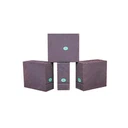
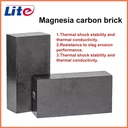
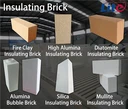
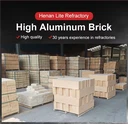
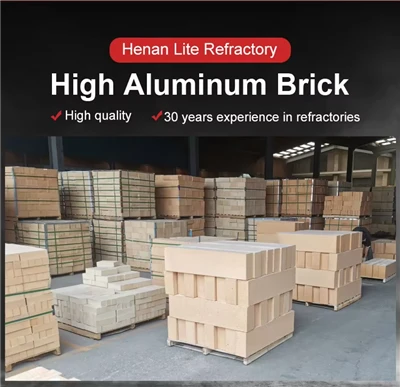
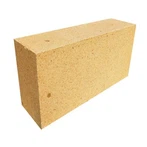
High alumina brick is a kind of alumina-silicate refractory material with content of alumina oxide more than 48%.usually made of high bauxite as the main raw material, through high temperature calcination. It has excellent fire resistance and high temperature resistance, and is often used in a variety of industrial furnaces, melting furnaces, glass kilns and other high temperature equipment lining and masonry. High aluminum refractory bricks usually have a high refractoriness and can withstand high temperatures of more than 1700 degrees Celsius, so they are widely used in industrial production.
High refractoriness: The refractoriness of high alumina bricks can reach 1750℃-1790℃, which is higher than that of clay bricks and semi-silica bricks. They are classified as advanced refractory materials and can remain stable at high temperatures without melting easily. High softening temperature under load: High alumina products have a high content of Al₂O₃ and a low content of impurities, resulting in less formation of fusible glassy phase. Therefore, their softening temperature under load is higher than that of clay bricks, generally ranging from 1420℃ to 1530℃. Strong slag resistance: High alumina bricks have a high content of Al₂O₃, approaching neutral refractory materials. They can resist the erosion of both acidic and alkaline slags. However, due to the presence of SiO₂, their resistance to alkaline slags is slightly weaker than that to acidic slags. Good thermal shock resistance: In industrial production, furnaces and other equipment often experience drastic temperature changes. High alumina bricks can withstand such thermal shock impacts without cracking or peeling, ensuring the stability and continuity of equipment operation. High compressive strength at room temperature: The compressive strength of high alumina bricks at room temperature is relatively high, ranging from 40MPa to 70MPa depending on the content of alumina. They can withstand significant pressure without deformation or damage. Good chemical stability: High alumina bricks have good corrosion resistance in acidic, alkaline, and neutral environments, and can resist the erosion of various chemical substances, making them widely used in furnaces and kilns in the chemical and metallurgical industries.
Small dimensional change on re-firing: If high alumina bricks are fired at a sufficient temperature and for an adequate time, their volume is stable and the dimensional change on re-firing is small. Conversely, if the firing temperature is insufficient or the firing time is inadequate, recrystallization occurs inside the product, leading to residual shrinkage.
High alumina brick applications
I. Metallurgical IndustrySteel Industry:
High-temperature blast furnace: Used in the furnace body, furnace waist, etc., to resist the wear and erosion caused by materials such as iron ore and coke.
Hot blast stove: As the inner lining of the combustion chamber and heat storage chamber, it withstands the repeated action of high-temperature flue gas and hot air, and requires good thermal shock resistance. Reactor, electric arc furnace: Used in certain areas of the furnace lining to resist the chemical erosion and high-temperature impact of molten steel and slag.
Non-ferrous metal smelting: Aluminum electrolytic cell: The inner lining part uses high-alumina bricks to resist the corrosion of molten electrolyte (sodium aluminate). Copper, zinc, etc. smelting furnaces: As the structural material of the furnace body, they can withstand the high temperature and slag erosion during the smelting process.
II. Building Materials IndustryCement Industry: Rotary kiln: Used in the high-temperature areas such as the kiln mouth and the firing zone, to resist the erosion of the cement raw material melt formed into clinker, as well as the scouring of high-temperature gas.
Preheater, decomposition furnace: Some high-temperature sections use high-alumina bricks to improve the equipment's high-temperature stability.
Glass Industry: Glass melting kiln: The pool wall, chest wall, etc. are used, to withstand the erosion of the molten glass liquid (the glass liquid contains SiO₂ and other components, which will react with refractory materials), and also require good insulation performance. III. Chemical IndustryFertilizer Industry: In the gasification furnace, reformer, etc. of the synthesis ammonia plant, high-alumina bricks are used in the inner lining to resist the erosion of high-temperature gas and chemical media.
Coal chemical industry: Gasification furnace, coal tar distillation furnace, etc. of the equipment, using high-alumina bricks' high-temperature and chemical erosion resistance to ensure the long-term stable operation of the equipment.
IV. Power IndustryBoiler: The combustion chamber, superheater area of large power station boilers, and the high-temperature section of waste incineration boilers, use high-alumina bricks to resist direct flame scouring and high-temperature gas erosion.
Superheater boiler: Used in the high-temperature heat recovery position, to improve the equipment's fire resistance and service life. V. Other Industrial FieldsCeramic industry: The high-temperature zone lining of ceramic kiln furnaces (such as tunnel kilns, roller kilns) withstand the high-temperature environment during the firing of ceramic bodies.
Waste treatment: The furnace lining of waste incinerators, to resist the high temperature and complex corrosive gases (such as HCl, SO₂, etc.) generated by waste incineration erosion.
FAQ
1.Are we a manufacturer or supplier?
We are a manufacturer. Our company was established in 1994 and has been dedicated to refractory materials for 30 years. Our customers are spread across 120+ countries, and we serve over 3,000+ global customers. We have four major production bases, with an area of over 50,000 square meters. Our annual production capacity is 150,000 tons, and we have a complete product line to ensure production capacity and delivery time.
2.Do you offer product customization?
Support customization, with over 150 patents, capable of developing new products within 7 days for each model, and 300+ sets of molds available for free sample production.
3.How do you conduct quality testing on your products?
We strictly follow the quality management system, and we have a logistics chemistry laboratory. Here are some of the ways we conduct quality testing: 1) Raw material inspection 2) In-process inspection 3) Finished product inspection 4) Performance testing 5) Stability testing
6) The product qualification rate of the factory is ≥ 99.5%, and a test report is provided for each batch of products.
4.What is your delivery time?
Usually, the goods will be dispatched within 7 to 15 days after the deposit is received. For urgent orders, please contact us to obtain a faster solution. We can dispatch the goods within 72 hours.
5.Can you provide samples?
Yes, free samples are available. Customers only need to cover the shipping cost. 6. How is the after-sales service of your company?
Global after-sales support, 24-hour response, with 3 international engineering teams, supporting the implementation of global projects, with the fastest response time of 24 hours. 9S one-stop service system, integrated engineering services, providing full-process engineering solutions including design, production, construction, training, and after-sales, helping customers reduce costs and increase efficiency.
7.Why choose us over other suppliers?
We have a large scale, strong strength, and rich experience, professional technology, and perfect customer service, and have obtained various certifications such as CE/ISO9001/ISO45001/CNAS/SGS.
8.What are your payment methods?
A-We accept various payment methods, including credit cards, PayPal, bank transfer, and Western Union. The specific payment method can be negotiated.
Hot Tags: high alumina brick high quality, China high alumina brick high quality suppliers, manufacturers, factory
Technical parameters of high alumina bricks
Grade 1 high alumina bricks with a refractoriness of ≥75% have the best performance, the highest refractoriness and load-softening temperature, and are suitable for critical parts with ultra-high temperatures
Grade 2 high alumina bricks, with a comprehensive performance of 60% to 75%, have a balanced overall performance and high cost performance. They are the most widely used grade in industrial furnaces and kilns
Grade three high alumina bricks, with 48% to 60% of their performance close to that of clay bricks, have a slightly higher refractoriness and are suitable for medium and high-temperature non-critical areas