Latest Products


Contact Us
- No.92 Jianshe West Road, Zhongyuan District, Zhengzhou, Henan,China.
- albert@literefractory.com
- +8619937887923

China High Quality CA70 CA75 CA80 Fire Resistant Aluminate Cement White Color Refractory Cement For Kiln
Refractory cement also called heatresistant cement or high-temperature cement is a hydraulic binder designed to withstand extreme heat, chemical erosion, and thermal shock. It is formulated by blending.
Description
Lite Refractory Cement: The Ultimate Guide to High-Temperature Construction Materials
http://lite-kilnrefractory.com
Introduction: Why Refractory Cement Matters in High-Temperature Industries
In industries where extreme heat is the norm-steel manufacturing, glass production, kiln operations, and power generation-materials that can withstand temperatures exceeding 1,000°C are non-negotiable. Refractory cement, a specialized binding agent engineered for thermal stability, stands as the backbone of these high-temperature environments. Unlike ordinary Portland cement, which degrades above 300°C, refractory cement maintains structural integrity even under prolonged exposure to 1,200°C–1,800°C conditions. This guide unpacks its composition, types, applications, and selection criteria to help engineers, contractors, and procurement managers make informed decisions.

What Is Refractory Cement?
Refractory cement (also called heat-resistant cement or high-temperature cement) is a hydraulic binder designed to withstand extreme heat, chemical erosion, and thermal shock. It is formulated by blending:
Refractory aggregates: Alumina (Al₂O₃), silica (SiO₂), magnesia (MgO), or zirconia (ZrO₂) (60–80% of the mix).
Binders: Calcium aluminate cement (CAC), Portland cement (limited use), or phosphate-based binders (for ultra-high temperatures).
Additives: Plasticizers, retarders, or fibers to enhance workability and mechanical strength.
The key distinction from regular cement lies in its refractoriness under load (RUL)-a measure of its ability to resist deformation under heat and pressure. Most refractory cements have an RUL above 1,500°C, making them ideal for lining furnaces, boilers, and incinerators.
Types of Refractory Cement: Choosing the Right Grade for Your Project
Refractory cements are categorized by their chemical composition and maximum service temperature. Below are the most common types used in industrial applications:

Applications: Where Refractory Cement Shines
Refractory cement is indispensable across industries that demand heat containment and structural durability. Here are its top use cases:
| Industry | Application | Recommended Type |
|---|---|---|
| Steel Manufacturing | Furnace linings, tundishes, ladle refractories | Alumina-based (60–70% Al₂O₃) |
| Glass Production | Glass tank linings, forehearths, and annealing lehrs | Silica-alumina blend |
| Cement Industry | Rotary kiln linings, preheater towers, and clinker coolers | Magnesia-spinel or high-alumina |
| Power Generation | Boiler fireboxes, incinerators, and biomass reactors | High-alumina (70–80% Al₂O₃) |
| Petrochemical | Catalytic crackers, reformers, and thermal oxidizers | Phosphate-bonded (acid-resistant) |
How to Use Refractory Cement: Installation Best Practices
Proper mixing, application, and curing are critical to maximizing refractory cement performance. Follow these steps for optimal results:
1. Surface Preparation
Clean the substrate (metal or refractory brick) to remove oil, rust, or loose debris.
Pre-wet porous surfaces (e.g., firebricks) to prevent rapid moisture loss from the cement.
2. Mixing
Use clean, dry tools and containers (metal or plastic; avoid wood, which absorbs water).
Mix 1 part cement to 2–3 parts refractory aggregate (e.g., alumina grog or silica sand) for mortar applications.
Add water gradually (5–8% of total weight) until a workable paste is formed (similar to peanut butter consistency).
3. Application
Apply in layers ≤25mm thick to avoid cracking during curing.
Use a trowel or spray gun for even coverage; vibrate to remove air bubbles.
4. Curing
Air-cure for 24–48 hours at room temperature (avoid rapid drying or freezing).
Heat-cure gradually: Raise temperature by 50°C/hour up to 200°C, hold for 2 hours, then increase to 600°C for final setting.
Key Properties to Consider When Selecting Refractory Cement
To ensure long-term performance, evaluate these critical parameters:
Refractoriness: Maximum temperature resistance (match to your equipment's operating range).
Thermal shock resistance: Ability to withstand rapid temperature changes (measured by cycles of heating/cooling).
Compressive strength: Load-bearing capacity at operating temperature (typically 5–20 MPa at 1,000°C).
Chemical resistance: Compatibility with slags, gases, and molten metals (acidic vs. basic environments).
Shrinkage: Low drying and firing shrinkage (<2%) to prevent cracking.
Troubleshooting Common Refractory Cement Issues
| Problem | Cause | Solution |
|---|---|---|
| Cracking during curing | Rapid moisture loss or thick application | Slow curing; apply in thin layers (<25mm) |
| Poor adhesion to substrate | Contaminated surface or incorrect mixing | Clean substrate; adjust water-to-cement ratio |
| Spalling (surface flaking) | Thermal shock or low alumina content | Switch to high-alumina grades (>60% Al₂O₃) |
| Reduced strength at high temp | Incorrect aggregate sizing or binder type | Use graded aggregates and CAC binders |
Conclusion: Investing in Quality Refractory Cement
Refractory cement is not just a construction material-it's a critical component of industrial safety, efficiency, and equipment longevity. By selecting the right type (alumina, silica, magnesia, or phosphate-bonded) and following best practices for installation, businesses can minimize downtime, reduce maintenance costs, and ensure compliance with high-temperature safety standards.
For sourcing high-performance refractory cement tailored to your industry, contact our technical team for personalized recommendations and bulk pricing.
FAQs About Refractory Cement
Q1: Can refractory cement be used with regular concrete?
A1: No-regular concrete degrades at 300°C, so it will weaken the refractory lining. Use refractory aggregates only.
Q2: What's the shelf life of refractory cement?
A2: 6–12 months in sealed containers; store in a dry, cool area to prevent moisture absorption.
Q3: Is refractory cement fireproof?
A3: Yes-it is designed to withstand direct flame contact and extreme heat without combustion.
About us:
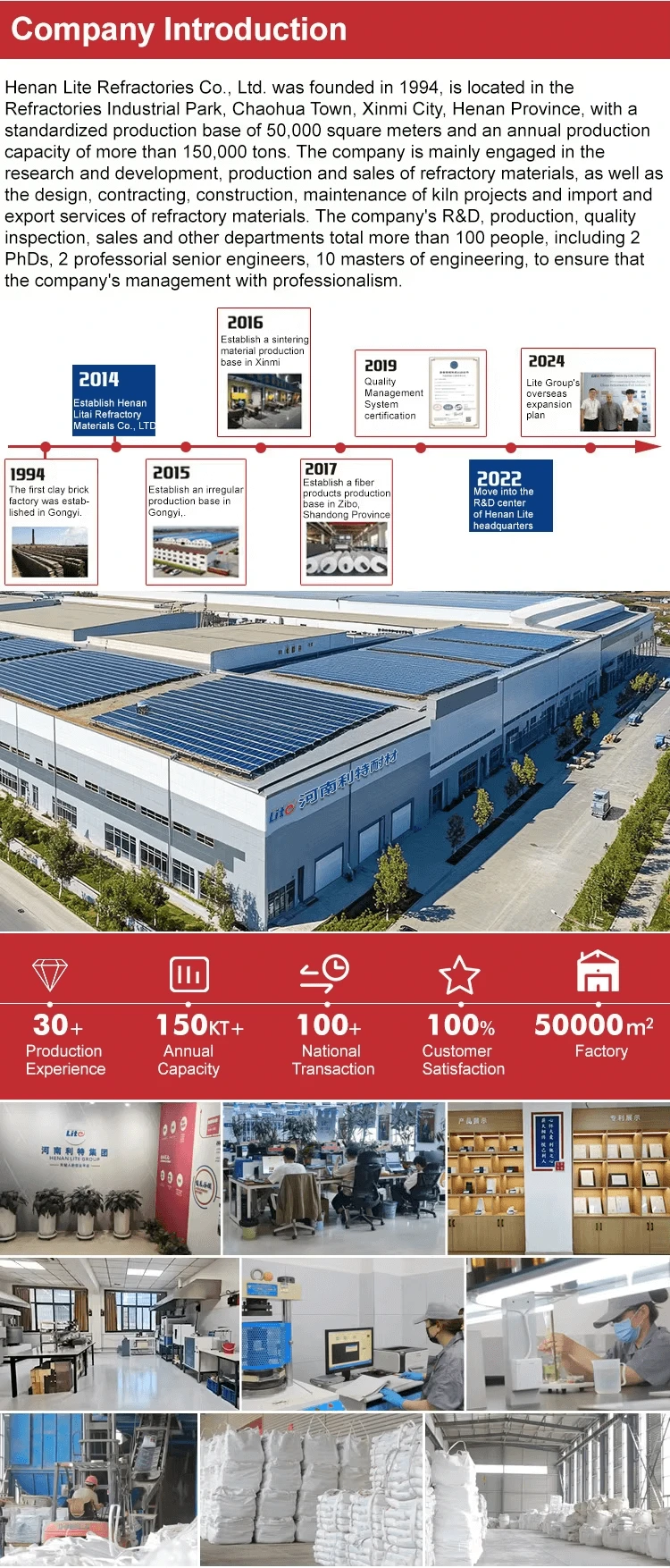
1.Are we a manufacturer or supplier? We are a manufacturer. Our company was established in 1994 and has been dedicated to refractory materials for 30 years. Our customers are spread across 120+ countries, and we serve over 3,000+ global customers. We have four major production bases, with an area of over 50,000 square meters. Our annual production capacity is 150,000 tons, and we have a complete product line to ensure production capacity and delivery time.
2.Do you offer product customization? Support customization, with over 150 patents, capable of developing new products within 7 days for each model, and 300+ sets of molds available for free sample production.
3.How do you conduct quality testing on your products? We strictly follow the quality management system, and we have a logistics chemistry laboratory. Here are some of the ways we conduct quality testing: 1) Raw material inspection 2) In-process inspection 3) Finished product inspection 4) Performance testing 5) Stability testing 6) The product qualification rate of the factory is ≥ 99.5%, and a test report is provided for each batch of products.
4.What is your delivery time? Usually, the goods will be dispatched within 7 to 15 days after the deposit is received. For urgent orders, please contact us to obtain a faster solution. We can dispatch the goods within 72 hours.
5.Can you provide samples? Yes, free samples are available. Customers only need to cover the shipping cost.
6. How is the after-sales service of your company? Global after-sales support, 24-hour response, with 3 international engineering teams, supporting the implementation of global projects, with the fastest response time of 24 hours. 9S one-stop service system, integrated engineering services, providing full-process engineering solutions including design, production, construction, training, and after-sales, helping customers reduce costs and increase efficiency.
7.Why choose us over other suppliers? We have a large scale, strong strength, and rich experience, professional technology, and perfect customer service, and have obtained various certifications such as CE/ISO9001/ISO45001/CNAS/SGS.
8.What are your payment methods? A-We accept various payment methods, including credit cards, PayPal, bank transfer, and Western Union. The specific payment method can be negotiated.

Hot Tags: china high quality ca70 ca75 ca80 fire resistant aluminate cement white color refractory cement for kiln, China china high quality ca70 ca75 ca80 fire resistant aluminate cement white color refractory cement for kiln suppliers, manufacturers, factory
You Might Also Like