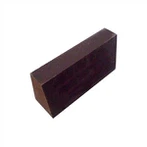
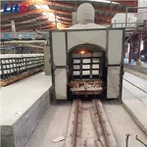
Today, a technician from Henan Lite refractory bricks will share with you the problems that must be paid attention to in the construction of refractory bricks in the kiln. I hope that the sharing can help you.
1. Clean the inside of the kiln shell. The welds and scratches of the kiln shell should be polished and smooth; the unevenness of the kiln shell should be leveled before laying bricks.
2. Select bricks before laying: there may be a corner damage on the hot and cold surface, the sum of the length of the corner damage of the three edges of the corner damage should not exceed 50mm; the crack on the brick surface should not be longer than 40 mm and not wider than 0.2 mm; the width of the large and small ends The tolerance is ±2 mm, the difference tolerance of the size head is ±1 mm, and the length tolerance is ±2 mm.
3. Bricklaying line: one longitudinal reference line is placed every 1.5 meters along the circumference, and the longitudinal line is parallel to the kiln axis; the circular reference line is placed every 1 meter, and the loop lines are parallel to each other and perpendicular to the kiln axis.
4. When paving refractory bricks, the height of the back cannot exceed the height of the front. Two hundred percent should be guaranteed when laying bricks.
5. It is strictly forbidden to reverse the size of the head, and each brick should be hit hard with a mallet on the big surface to make it contact densely.
6. The brick joints are required to be straight, the upper and lower opening widths are consistent, the brick joint width is not more than 2 mm, the girth joint deviation is not more than 2 mm per meter, and the total ring length deviation is not more than 8 mm; the curved surface is flat, the joints are tight, and the bricks are tight. Stick the kiln shell.
7. It is not allowed to put two wedge irons in a brick joint at the same time, and each ring can not add more than three wedge irons (as far as possible under the premise of satisfying the wedge tightness, use less adjustment irons and wedge irons, and thin lock bricks cannot be used as wedge iron entrances) .
8. When laying to the closed position, insert the joint bricks with the big head inside and the small head outside, not upside-down. When locking the bricks at the same time, do not use two interlocking bricks in a row, and stagger the adjacent ring locking bricks, and use as little as possible for each ring locking brick.
9. Finally, when the bricks are driven into the trivial bricks, a wooden board should be used to pad the bricks, not directly on the brick surface. When unloading the jack, you must hit the bricks on both sides with a mallet in time.
10. When the refractory bricks are wet-laid, the fire mud is consistent with the material of the bricks, and the fire mud joints are not larger than 2mm. In winter, heat preservation measures shall be taken to prevent the fire mud from freezing.
11. Strictly control and adjust the amount of iron. It is strictly forbidden to add adjustment iron on both sides of the same ring brick.
12. The processing of refractory bricks should be standardized, with moderate tightness, hammering and trowel cutting are strictly prohibited, and the length of the processed bricks should not be less than 120mm.
13. The refractory bricks should be covered with protective materials such as rubber belts in time.
14. Liquids such as water and oil are not allowed to be brought into the rotary kiln (urine in the kiln is strictly prohibited) to avoid moisture or pollution of the refractory bricks.
15. Handle refractory bricks with care. Remove the burrs and fine slag on the brick surface and corners before laying, and keep the brick laying surface and the kiln shell clean. Clean up along with the laying.
16. Forklifts are not allowed to roll refractory bricks that are laying the bottom.
17. The refractory bricks on the north side of the block ring (in the direction of the kiln end) should be close to the block ring.
18. After the masonry is completed, fasten it with the lock steel plate from the top ring by ring, then turn it 180 degrees, and then check the fastening from the top.