Latest Products



Contact Us
- No.92 Jianshe West Road, Zhongyuan District, Zhengzhou, Henan,China.
- albert@literefractory.com
- +8619937887923


Standard Size Lightweight Refractory Bricks Clay Insulating Blocks With CE Certificate
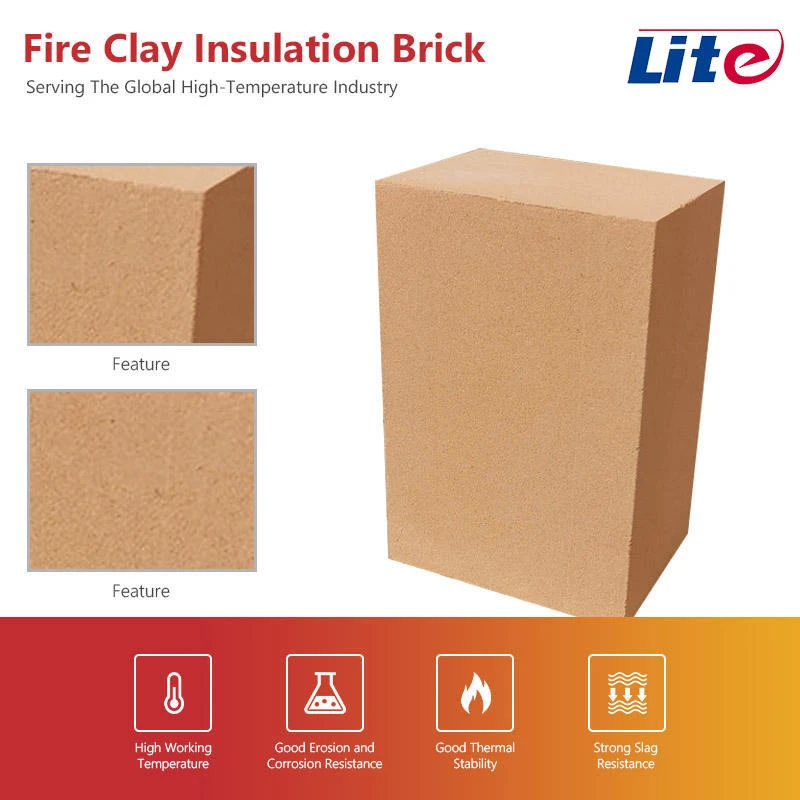
Fireclay insulation brick is a kind of lightweight refractory products, its aluminum ₂O₃ content is 18%-46%. Bulk density 0.8-1g/m³ . It is made of clay clinker or light clinker and plastic clay as the main raw material, usually produced by fuel method, but also by chemical method or foaming method to form a porous structure. Applicable temperature range is 900℃ to 1300℃, Firing temperature range: 1580℃ to 1770℃,can withstand high temperature environment.
Description
overview of fire clay insulating bricks
Fireclay insulation brick is a kind of lightweight refractory products, its aluminum ₂O₃ content is 18%-46%. Bulk density 0.8-1g/m³ . It is made of clay clinker or light clinker and plastic clay as the main raw material, usually produced by fuel method, but also by chemical method or foaming method to form a porous structure. Applicable temperature range is 900℃ to 1300℃, Firing temperature range: 1580℃ to 1770℃,can withstand high temperature environment.

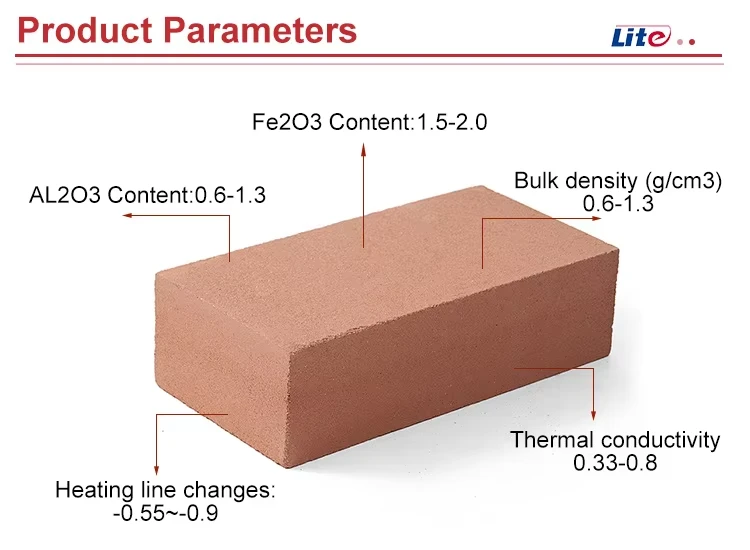
parameters of clay insulating bricks
|
Item |
NG0.6 |
NG0.8 |
NG1 |
NG1.3 |
|
Al2O3(%) |
≥18 |
≥26 |
≥35 |
≥40 |
|
Fe2O3(%) |
≤1.5 |
≤1.5 |
≤1.2 |
≤2 |
|
SiO2(%) |
≤55 |
≤55 |
≤55 |
≤55 |
|
Bulk density (g/cm³) |
≤0.6 |
≤0.8 |
≤1.0 |
≤1.7 |
|
Apparent porosity(%) |
≥70 |
≥60 |
≥55 |
≥50 |
|
Compressive strength at room temperature (MPA) |
≥2 |
≥2.5 |
≥3 |
≥4 |
|
Heating line changes(%)℃*12H ≤ |
-0.5 (1300℃*12H) |
-0.5 (1350℃*12H) |
-0.9 (1350℃*12H) |
-0.9 (1350℃*12H) |
|
Thermal conductivity (W/m.k)(1000℃) |
0.33 |
0.6 |
0.45 |
0.8 |
Features of fire clay insulating bricks
Excellent fire resistance:
applications of fire clay insulating bricks
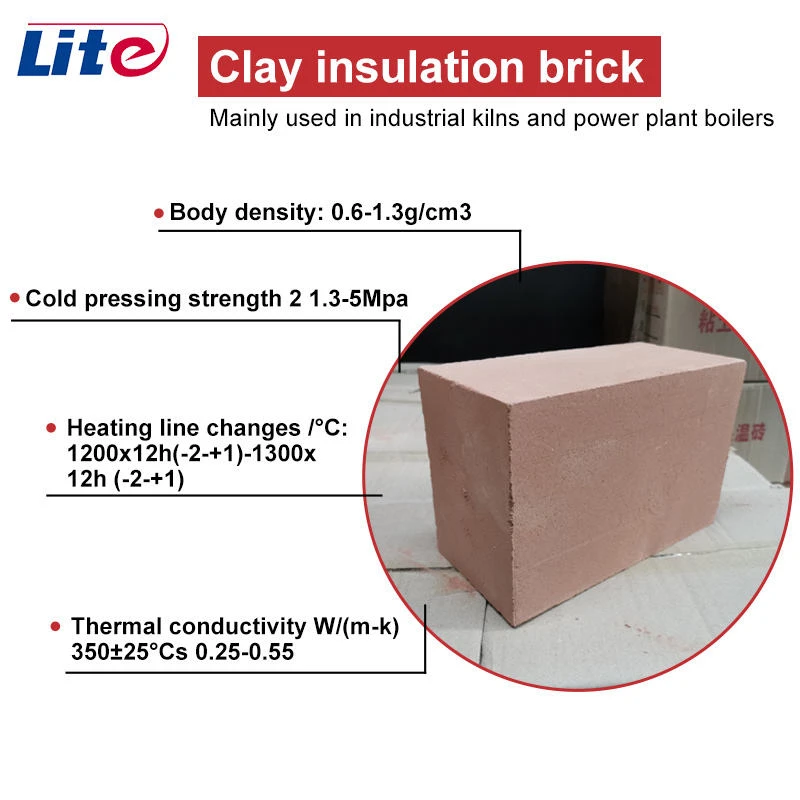
. Metallurgical Industry This is one of the largest application fields of refractory clay insulation bricks. Iron smelting system: Furnace lining: The insulation layer for the furnace body, furnace waist, furnace belly and other parts of the furnace, which protects the furnace shell, lowers the surface temperature and reduces heat loss. Hot blast stove: As the insulation layer for the dome of the hot blast stove, the combustion chamber, and the walls of the heat storage chamber, it is of vital importance for increasing the air temperature and saving energy. Steel-making system: Steel ladle/Intermediate ladle: As a permanent layer, it is constructed between the working linings (such as magnesia-carbon bricks, castable materials) of the steel ladle and the intermediate ladle and the steel shell, serving the functions of insulation and protecting the steel shell. Rolling steel system: Heating furnace: Widely used in the furnace top, furnace walls and furnace bottom of push-type and step-type heating furnaces. As a heat insulation layer, it can significantly reduce fuel consumption.
II. Building Materials Industry Cement Industry: Cement rotary kiln: Primarily used as the insulation layer for the kiln tail preheater system, decomposition furnace, kiln door cover, cooling machine and other equipment. It does not directly come into contact with high-temperature flames, but can effectively maintain the system temperature and improve thermal efficiency. Glass Industry: Glass melting kiln: It is used for heat preservation of the bottom of the kiln, insulation of the abutment walls, and heat preservation of the storage chambers, etc. It has a significant effect on maintaining the stable temperature inside the kiln and reducing energy consumption. Ceramic industry: Tunnel kilns, shuttle kilns, and belt kilns: These are indispensable thermal insulation materials for the kiln bodies and kiln carts of various ceramic kilns. They are used on the kiln roof, kiln walls, and kiln cart tabletops, effectively improving the uniformity of the kiln interior temperature and saving fuel.
III. Petrochemical and Chemical Industries Petrochemical facilities: Ethylene cracking furnace, hydrogen production reformer, steam boiler: The furnace walls of these large thermal equipment usually adopt a structure of "fire-resistant working surface layer + insulation brick layer", and clay insulation bricks are the ideal insulation material. Coking Industry: Furnace: Thermal insulation for the furnace doors, riser pipes, and heat storage chambers of the coke oven.
IV. Mechanical Manufacturing and Heat Treatment Industry Heat Treatment Furnace: Such furnaces as annealing furnaces, normalizing furnaces, tempering furnaces, and carburizing furnaces generally adopt refractory clay insulation bricks as the insulation layer for the furnace body structure, in order to ensure uniform furnace temperature and process stability.
V. Electric Power Industry Power Station Boilers: In the boilers of coal-fired power plants or waste incineration plants, the parts of the furnace walls that do not come into direct contact with the flame are used as insulation materials.
VI. Other Industrial and Civilian Fields Garbage Incinerator Non-ferrous metal smelting furnaces (such as insulation layers for aluminum and copper smelting furnaces) High-temperature muffle ovens and box-type furnaces used in the laboratory.
Our advantages
Energy conservation and consumption reduction:


FAQ
1.Are we a manufacturer or supplier? We are a manufacturer. Our company was established in 1994 and has been dedicated to refractory materials for 30 years. Our customers are spread across 120+ countries, and we serve over 3,000+ global customers. We have four major production bases, with an area of over 50,000 square meters. Our annual production capacity is 150,000 tons, and we have a complete product line to ensure production capacity and delivery time.
2.Do you offer product customization? Support customization, with over 150 patents, capable of developing new products within 7 days for each model, and 300+ sets of molds available for free sample production.
3.How do you conduct quality testing on your products? We strictly follow the quality management system, and we have a logistics chemistry laboratory. Here are some of the ways we conduct quality testing: 1) Raw material inspection 2) In-process inspection 3) Finished product inspection 4) Performance testing 5) Stability testing 6) The product qualification rate of the factory is ≥ 99.5%, and a test report is provided for each batch of products.
4.What is your delivery time? Usually, the goods will be dispatched within 7 to 15 days after the deposit is received. For urgent orders, please contact us to obtain a faster solution. We can dispatch the goods within 72 hours.
5.Can you provide samples? Yes, free samples are available. Customers only need to cover the shipping cost.
6. How is the after-sales service of your company? Global after-sales support, 24-hour response, with 3 international engineering teams, supporting the implementation of global projects, with the fastest response time of 24 hours. 9S one-stop service system, integrated engineering services, providing full-process engineering solutions including design, production, construction, training, and after-sales, helping customers reduce costs and increase efficiency.
7.Why choose us over other suppliers? We have a large scale, strong strength, and rich experience, professional technology, and perfect customer service, and have obtained various certifications such as CE/ISO9001/ISO45001/CNAS/SGS.
8.What are your payment methods? A-We accept various payment methods, including credit cards, PayPal, bank transfer, and Western Union. The specific payment method can be negotiated.
Hot Tags: standard size lightweight refractory bricks clay insulating blocks with ce certificate, China standard size lightweight refractory bricks clay insulating blocks with ce certificate suppliers, manufacturers, factory
|
Item |
NG0.6 |
NG0.8 |
NG1 |
NG1.3 |
|
Al2O3(%) |
≥18 |
≥26 |
≥35 |
≥40 |
|
Fe2O3(%) |
≤1.5 |
≤1.5 |
≤1.2 |
≤2 |
|
SiO2(%) |
≤55 |
≤55 |
≤55 |
≤55 |
|
Bulk density (g/cm³) |
≤0.6 |
≤0.8 |
≤1.0 |
≤1.7 |
|
Apparent porosity(%) |
≥70 |
≥60 |
≥55 |
≥50 |
|
Compressive strength at room temperature (MPA) |
≥2 |
≥2.5 |
≥3 |
≥4 |
|
Heating line changes(%)℃*12H ≤ |
-0.5 (1300℃*12H) |
-0.5 (1350℃*12H) |
-0.9 (1350℃*12H) |
-0.9 (1350℃*12H) |
|
Thermal conductivity (W/m.k)(1000℃) |
0.33 |
0.6 |
0.45 |
0.8 |
You Might Also Like