High aluminum standard brick is a kind of refractory material, so what are the characteristics of this material? Where are they used in production and life? What conveniences and benefits does the application of this material bring to people's lives? Let's ask the professionals! Let's take a closer look at "Analysis of the quality of high-alumina standard bricks and analysis of product efficacy".
[How to judge the quality of high aluminum standard bricks]
How can high-alumina refractory bricks be used well or not? First choose the manufacturer, which is the refractory base for various industries. There are many high alumina brick manufacturers. The rich bauxite has created high-quality products. Rongsheng Refractories has focused on the production and sales of refractory materials for many years. We have accumulated a wealth of experience in the production and use of materials, and can provide high-quality products and projects for customers.
A good high-temperature-resistant high-alumina brick also needs to be tempered by powerful pressing equipment. How to make a normal square brick have the function of high-temperature resistance? In addition to the elements that need to be mixed by itself, refractory sintering must be implemented to implement ceramic bonding for high temperature and high alumina bricks.
After refractory sintering, about 20% may be lost. Important, it doesn’t matter, the rest is all the essence. In the true sense, high-temperature and high-alumina bricks must not only be able to withstand fire resistance, but more importantly, be able to withstand the drastic transition between cold and heat (thermal shock resistance).
It can be seen how difficult it is to produce a high-temperature and high-alumina brick, and it requires a lot of effort of the staff. And now high-temperature-resistant high-alumina bricks are divided into two types, one is fixed-shaped, the other is unshaped. Even high-temperature high-alumina bricks have different uses. This is also based on the high-temperature high-alumina bricks. The time experienced in the hot and cold environment is different. We should also pay attention to this when choosing related products. Don't be blinded by fakes.
There are many uses for high-alumina bricks, so how to see the effect of high-alumina refractory bricks is a question that customers are more concerned about, because various industries are commonly used in steel, steelmaking, hot blast stoves, electric furnace tops, blast furnaces, Industrial high-temperature furnaces such as reverberatory furnaces and rotary kiln linings are mainly mixed into high-bauxite bauxite; sillimanite group minerals (including kyanite, red base stone, sillimanite, etc.); artificially mixed into raw materials, Such as industrial alumina, mixed into mullite, fused zirconia corundum and so on.
High-alumina bricks have good application effects, high temperature resistance, long service life and other characteristics. They are important refractory brick products used in industrial high-temperature kilns. Basically, the application unit cannot correctly distinguish the use effect and grade of high alumina bricks when purchasing requirements, resulting in high-priced purchases of low-grade products, and then reducing the service life of high-temperature kilns, so look for refractory net here to briefly introduce Let's look at how to identify the effect of bricks when purchasing high-alumina bricks.
Appearance: When choosing the requirements of high alumina bricks, it is important to look at the appearance. Excellent high alumina bricks have lubricating surfaces, yellowish white, flat sides, no broken corners, and no cracks.
High-alumina high-temperature resistance weight: Weigh the weight of a single brick. According to the weight specification, the weight of the first-level high-alumina brick is 4.5 kg. 70 high alumina brick weighs 4.2 kg, 55 high alumina brick weighs 3.9 kg, equal grade, equal parameter type can be regarded as excellent high alumina brick, on the contrary, it can be regarded as excellent high alumina brick, if it does not reach this weight, the use effect is good. If there are cracks, uneven corners, broken corners, etc., it is a substandard product.
How to check for cracks in high alumina refractory bricks?
High-alumina refractory bricks are heterogeneous multiphase bodies, with relatively large cracks, cracks, etc., resulting in the actual thermal shock resistance index and the calculated value are not exactly the same, because the calculation is based on known parameters, based on the object Stress is the premise.
There are eight rules for crack inspection of high alumina bricks:
1) For crack inspection, use a steel ruler with a scale of 0.5 mm and a steel wire with a diameter equal to the measured crack width (for example: 0.1, 0.25, 0.5, 1.0 mm);
2) When inspecting the cracks of high alumina bricks, insert the steel wire into the width of the crack naturally. However, it must not be inserted into the place where the particles can be seen by the naked eye; where the 0.25mm steel wire cannot be inserted, the width is expressed as less than 0.25mm; where 0.25mm For cracks that can be inserted by steel wire but not by 0.5 mm steel wire, the width is represented by 0.25-0.5 mm, and so on;
3) When the crack is not in a straight line, it can be measured in sections. The total length of each line segment is the total length of the crack; a crack with a discontinuity in the middle and a distance of less than 5 mm (including unrestricted cracks) is a crack, and its length is calculated together , Except for cross-line cracks;
4) Cross-edge cracks, except in special cases, are calculated as continuous cracks. One crack crosses the working face and non-working face at the same time, and is always calculated according to the working face; the cracks that cross two edges at the corners shall not exceed the requirements of the missing angle. The range of values is not calculated based on the cross-edge; any cracks that are restricted under the provisions of the standard are not restricted by the cross-edge, and no inspection is performed;
5) Surfaces with grooves and ribs are calculated as one surface, except for high alumina bricks for casting; surfaces with through holes are calculated as two surfaces;
6) The high-alumina bricks form thin and long linear cracks due to improper cooling, which are cold cracks and should be treated as unqualified products;
7) Where several cracks form a closed curve, it is a network crack; when calculating the length of the network crack, the total length of the periphery shall prevail; where more than one crack intersects, it is a cross crack; when calculating the number of cross cracks , Subject to straight cracks;
8) The edge of the 120 degree angle of Dagan is not counted as the edge, and the surface whose size is less than 20 mm is not counted as the surface, except for high alumina bricks for casting.
[Analysis of product characteristics of high alumina standard bricks]
High alumina bricks are widely used in kiln masonry. High alumina bricks are a kind of refractory materials. The refractoriness of high alumina bricks is higher than that of clay bricks and semi-silica bricks. The standard size of high alumina bricks is related to the kiln. Calculation of brick consumption for furnace masonry.
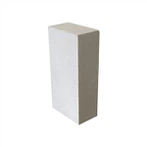
High aluminum standard brick is a commonly used national standard refractory brick model, size: 230*114*65, suitable for all kiln construction. At the same time, different materials can be selected according to the different use environment.
The first-grade high-alumina refractory brick refers to an aluminum silicate refractory material with an aluminum oxide content of not less than 75%. It is formed and calcined from bauxite or other raw materials with high alumina content.
Product Features
The characteristics of first-grade high-alumina refractory bricks: high thermal stability, refractoriness above 1790℃, high load softening temperature can reach above 1480°, good slag resistance, good thermal shock stability, resistance to acid, alkali, high temperature creep It has the characteristics of low rate of change and high strength at high temperature. It is a high-grade refractory material.
Applications
High alumina bricks are mainly used for electric furnace cover (furnace top), blast furnace (furnace body), hot blast stove partition wall, ladle lining, ladle, iron wagon, cement kiln, glass kiln and other thermal kiln lining . It is widely used in ironmaking, steelmaking, chemical, cement and other industries. Hongtong Refractories focuses on the production of high alumina bricks and looks forward to your cooperation!