Latest Products


Contact Us
- No.92 Jianshe West Road, Zhongyuan District, Zhengzhou, Henan,China.
- albert@literefractory.com
- +8619937887923



Types Of Unshaped Refractory Materials
Unshaped refractory materials play a pivotal role In the world of high-temperature industrial applications, . Unlike traditional refractory bricks or pre-formed shapes, these materials offer unparalleled flexibility and adaptability. But what exactly are unshaped refractory products, and how are they classified? Let’s dive in.
Description
What Are Unshaped Refractory Materials?
Unshaped refractory materials, also known as monolithic refractories, are materials that are installed in an unformed state. They are delivered to the site as powders, granules, or pre-mixed formulations and are then shaped or applied directly where needed. This flexibility makes them ideal for complex geometries, repairs, and custom applications.
Types of Unshaped Refractory Materials
The classification of unshaped refractory materialsis based on their composition, installation method, and application. Here are the primary types:
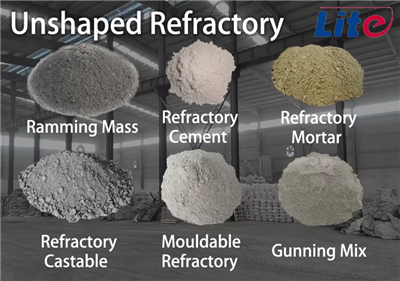
1. Refractory Castables
Refractory castables are the most widely used unshaped refractory product. They consist of dry mixes that, when combined with water, form a pourable slurry. These are ideal for:
Furnace linings
Kiln floors
Industrial boilers
2. Refractory Plastics
Plastic refractories are moldable materials that retain their shape after installation. They are often used for:
Patch repairs
Complex shapes
High-wear areas
3. Ramming Mixes
Ramming mixes are dense, dry materials that are compacted into place. They are commonly used in:
Blast furnaces
Induction furnaces
Ladle linings
4. Refractory Mortars
These are used to bond refractory bricks or shapes together. They come in various compositions to match the bricks they are bonding.
5. Gunning Mixes
Gunning mixes are sprayed onto surfaces using specialized equipment. They are ideal for rapid repairs and large surface areas.

Advantages of Unshaped Refractory Materials
The use of unshaped refractory materials offers several benefits:
Versatility: Can be applied to complex shapes and structures.
Cost-Effective: Reduces downtime and labor costs during installation.
Durability: Provides excellent resistance to thermal shock and corrosion.
Ease of Repair: Simplifies maintenance and extends the lifespan of equipment.
Applications of Unshaped Refractory Materials
These materials are used across a wide range of industries, including:
Steel and metal production
Cement and lime manufacturing
Glass and ceramics industries
Power generation
Petrochemical plants
Frequently Asked Questions
Q: What is the difference between shaped and unshaped refractory materials?
A: Shaped refractories come in pre-formed bricks or tiles, while unshaped refractory materials are applied in a loose or moldable state and then shaped on-site.
Q: How do I choose the right type of unshaped refractory material?
A: The choice depends on factors like temperature requirements, chemical exposure, and the specific application. Consulting with a refractory expert is recommended.
Q: Can unshaped refractory materials be used for high-temperature applications?
A: Yes, many unshaped refractory products are designed to withstand extreme temperatures, making them suitable for furnaces, kilns, and boilers.
Q: What is the lifespan of unshaped refractory materials?
A: The lifespan varies based on the material type, application, and operating conditions. Proper installation and maintenance can significantly extend their durability.
Hot Tags: types of unshaped refractory materials, China types of unshaped refractory materials suppliers, manufacturers, factory
You Might Also Like