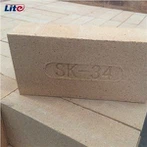
Refractory bricks can be divided into multiple types according to different production materials, so it has a wide range of applications. So what types of cement kilns are commonly used? The commonly used brick types are summarized as follows:
1. Silica brick: good thermal shock, high strength, good abrasion resistance, suitable for excessive belting.
2. Dolomite bricks: Good kiln-hanging performance and good corrosion resistance, but there are some f-CaO in the bricks, which are easy to hydrate, difficult to transport and store, and are less used in production.
3. Spinel bricks: mostly used for excessive belts, with good seismic performance and reduction resistance, but the refractoriness is slightly worse.
4. high alumina bricks: Al2O3 content is greater than 75, higher refractoriness than clay bricks, good acid and alkali corrosion resistance, suitable for cement kiln burning zone and other places, the use of refractory bricks has a long life but high prices.
5. Phosphate bricks: low refractoriness, but high strength and good thermal shock resistance. They are mostly used in grate coolers and kiln hoods.
6. silicon carbide brick: high temperature resistance (about 1800 degrees, load softening temperature in 1620-1640), small thermal expansion coefficient, good resistance to rapid cold and heat wear resistance, suitable for cooling zone and kiln mouth.
7. Silica brick: good thermal shock, high strength, good abrasion resistance, suitable for excessive belting.
8. Anti-flaking bricks: The anti-flaking bricks in the refractory bricks contain a small amount of ZrO. During the heating process, the Markov phase transformation occurs to form fine cracks. It has strong alkali resistance, peeling resistance and slag resistance.
For the use of refractory bricks in cement kilns, suitable product types can be selected according to the actual situation, so as to better meet the construction requirements.