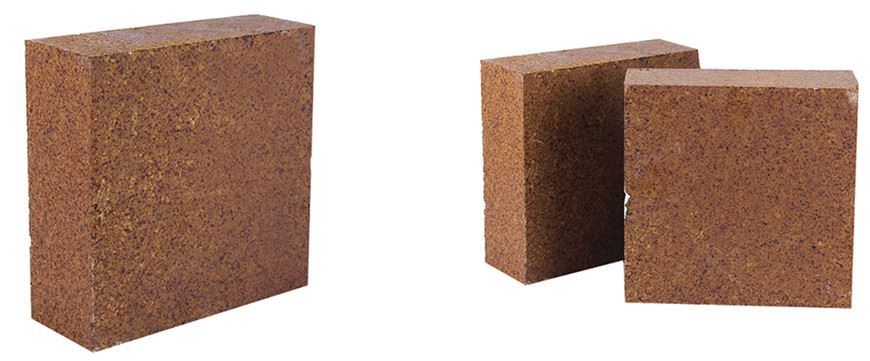
Magnesia alumina spinel brick is a kind of alkaline refractory bricks, mainly unfired and fired block bricks, and can also be synthesized into spinel to make amorphous refractory materials to form integral structures and gunning linings.
The production process of spinel refractory bricks is basically the same as that of ordinary magnesia bricks. However, the various levels of granular materials in the batching components are composed of sintered synthetic spinel or fused synthetic spinel, or a mixture of both. The fine powder can be light-burned spinel synthesized at 1000℃~1400℃, or a mixture of MgO and Al2O3.
The properties of magnesia-aluminum spinel bricks
The magnesia-aluminum spinel brick fired at a high temperature of 1750℃ has a very low porosity (less than 9%), with a bulk density of 3.22~3.23g/cm and a volume density of 2.9~3.1g/cm3 with a porosity of 12-17%. . The direct bonding rate between the high melting point crystal grains in the refractory brick is very high, so the strength at room temperature and high temperature is very high, the softening temperature under load is 1700~1750℃, and the creep resistance is also very strong. This kind of refractory brick has strong resistance to the penetration of silicate and iron-containing slag, and is not easy to form a thick metamorphic layer, especially when the brick contains a small volume of pores of 8-25μm. At the same time, it has excellent resistance to direct erosion by molten slag. In short, the slag resistance is far superior to magnesia alumina bricks.
Magnesia-aluminum spinel bricks have low volatility in vacuum, especially synthetic spinel bricks based on molten particles, which have good resistance to vacuum volatilization. Because this kind of spinel has a low thermal expansion coefficient of 8.2×10⁻⁶/℃, it also has better thermal shock resistance. The water cooling cycle at 1300℃ can reach 6 to 13 times. But when there is too much MgO or A12O3 in the refractory bricks, when the amount of solid solution in MA dissolves and precipitates with changes in temperature, its thermal shock resistance will be reduced. In addition, since the amount of iron-containing oxide is small, the volume stability is good when the atmosphere changes.
The use of magnesia-aluminum spinel bricks
Magnesium-aluminum spinel bricks are used in the lining of non-ferrous metal smelting furnaces in steel nickel furnaces and aluminum smelting furnaces, electric furnace covers, ladle linings, linings of vacuum treatment devices for refining outside the steelmaking furnaces, and in the high temperature zone of cement kiln Refractory products for lining, steel-making open-hearth furnace regenerator and glass furnace rose heat chamber checker bricks.