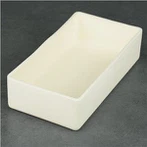
Alumina ceramic crucibles are essential tools in various industries, including metallurgy, chemistry, and materials science. They are prized for their excellent thermal shock resistance, high-temperature stability, and chemical inertness. The process of manufacturing these crucibles involves several key steps:
Raw Material Preparation:
High-Purity Alumina Powder: The primary raw material is high-purity alumina powder (Al₂O₃). The purity level is crucial for the final properties of the crucible.
Additives: Depending on the desired properties, additional materials like silica, magnesia, or other oxides may be added to the alumina powder. These additives can improve specific properties like thermal shock resistance or mechanical strength.
Mixing and Forming:
Mixing: The alumina powder and any additives are thoroughly mixed to ensure a homogeneous distribution. This can be done using ball milling, mixing mills, or other techniques.
Forming: The mixed powder is then shaped into the desired crucible form. Common forming techniques include:
Slip Casting: A slurry of the powder and water is poured into a plaster mold, where the water is absorbed, leaving a solid ceramic shape.
Plastic Forming: The powder is mixed with a binder to form a plastic mass that can be shaped by extrusion or pressing.
Injection Molding: The powder is mixed with a binder and injected into a mold under high pressure.

Drying:
Removal of Moisture: The formed crucibles are dried to remove excess moisture. This can be done in drying ovens or by air drying.
Firing:
Bisque Firing: The dried crucibles are fired at a relatively low temperature to remove any remaining organic binders and to strengthen the structure.
High-Temperature Firing: The bisque-fired crucibles are then fired at a high temperature, typically above 1600°C, to sinter the alumina particles and create a dense, ceramic structure. This high-temperature firing process imparts the desired properties to the crucible, such as high-temperature resistance, chemical inertness, and mechanical strength.
Finishing and Inspection:
Machining: If necessary, the fired crucibles can be machined to achieve precise dimensions and surface finishes.
Inspection: The final crucibles are inspected to ensure that they meet quality standards, including dimensional accuracy, surface finish, and mechanical strength.
Key Properties of Alumina Ceramic Crucibles:
High-Temperature Resistance: Alumina ceramic crucibles can withstand extremely high temperatures, making them suitable for melting metals and conducting high-temperature reactions.
Chemical Inertness: They are resistant to attack by most acids and alkalis, making them ideal for handling corrosive materials.
Thermal Shock Resistance: Alumina crucibles can withstand rapid temperature changes without cracking or breaking.
High Mechanical Strength: They possess excellent mechanical strength, allowing them to withstand the stresses of high-temperature use.
Electrical Insulation: Alumina is an excellent electrical insulator, making it suitable for use in electrical heating applications.