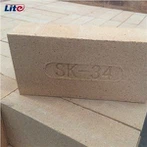
The siliceous refractory bricks are made of crushed and fired containing high silica, so the siliceous refractory bricks have good thermal performance. Because of the high silicate content, they have strong resistance to the erosion of water and ash. . When the refractoriness of silicon refractory brick reaches 1750℃, it can reach the softening point under load above 1520℃. Silica refractory bricks have poor heat resistance, and severe temperature fluctuations will damage silicon refractory bricks. That's because SiO2 changes its density as temperature changes, thus causing expansion and contraction.
SiO2 can exist in three crystalline forms, namely quartz, cristobalite and tridymite. And each type has several allotrope crystals. Each allotrope has different lattices and densities, and has stability in a certain temperature range, beyond which crystal transformation occurs. Increasing the thermal conductivity of siliceous refractory bricks is beneficial for coke oven strengthening, and increasing the density of siliceous refractory bricks can improve thermal conductivity. The price of siliceous refractory bricks for coke ovens varies according to the content of SiO2 used.