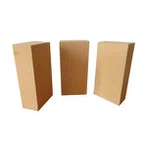
Clay insulation bricks refer to light refractory products containing Al2O330%-46%. They are mainly made of clay clinker or light clinker and plastic clay. They are usually produced by the combustible method, and can also be produced by chemical or foaming methods to form a porous structure. .
The content of Al2O3 in clay bricks in my country is generally more than 40%, and the content of Fe2O3 is less than 2.0~2.5%. The clinker in the ingredients is 65-85%, and the combined clay is 35-15%. The crushed combined clay and the finely ground clinker are mixed and ground, and then mixed with the granular clinker to prepare a semi-dry mud, which is molded under high pressure and fired at about 1400°C with good performance. Clay bricks are weakly acidic at high temperatures, and their ability to resist alkaline slag erosion is slightly worse, but it increases with the increase of Al2O3 content. The thermal stability is better than silica bricks and magnesia bricks (see magnesia bricks).
Clay insulation bricks have a wide range of uses, mainly used in various industrial kilns that do not touch the melt and have no corrosive gas insulation layer materials, and the use temperature is 1200-1400 ℃. Mainly used in thermal boilers, glass furnaces, cement furnaces, fertilizer gas furnaces, blast furnaces, hot blast furnaces, coking furnaces, electric furnaces, casting and steel casting bricks, etc.
Clay insulation bricks can also be used as hot surface refractories or other refractory materials to support the insulation layer, used in melting furnaces, ignition kilns, flues, refining devices, heating devices, regeneration devices, gas furnaces and pipelines, soaking furnaces, retreat Stoves, reaction chambers and other industrial thermal equipment.
Thermal insulation refractories refer to refractories with high porosity, low bulk density and low thermal conductivity. Thermal insulation refractories are also called lightweight refractories, which include thermal insulation refractory products, refractory fibers and refractory fiber products.
Thermal insulation refractories are characterized by high porosity, generally 40%-85%; low bulk density below 1.5g/cm3; low thermal conductivity, generally below 1.0W (m.K). It acts as a heat insulation material for industrial kilns, which can reduce the heat loss of the kiln, save energy, and reduce the quality of thermal equipment. Thermal insulation refractories have poor mechanical strength, abrasion resistance and slag corrosion resistance, and are not suitable for the load-bearing structure of the kiln and direct contact with slag, charge, molten metal and other parts.