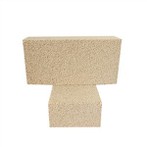
In general, the thermal conductivity of heavy mullite bricks used in high-temperature kilns is rarely considered. The thermal conductivity of heavy refractory bricks is greater than 1, and the thermal conductivity is often used for lightweight thermal insulation materials.
The thermal conductivity (thermal conductivity) of refractory bricks, that is, its ability to transfer heat, is usually expressed by thermal conductivity. The heat transfer coefficient refers to the amount of heat passed during the energy transfer process per unit area per unit time under unit temperature gradient.
In addition to temperature factors (such as high alumina bricks, magnesia bricks, etc.), the thermal conductivity of refractory bricks is closely related to its chemical mineral composition and organizational structure. In the preparation of refractory bricks by crystallization, the crystallization performance has a significant effect on the thermal conductivity.
The thermal conductivity of heavy mullite bricks refers to the coefficient of heat flow rate passing through a unit area under the action of a unit temperature gradient. The larger the porosity coefficient, the smaller the thermal conductivity.
In the production practice of general thermal equipment, the loss of heat after passing through the refractory bricks must be considered, and the insulation effect of the insulating refractory bricks needs to be calculated. For some flame-retardant heating furnaces, such as coke ovens, refractory bricks need to be considered. The thermal conductivity coefficient of the partition plate of the refractory brick is relatively large, so the thermal conductivity coefficient of the partition plate of the refractory brick is one of the key consideration indicators in the thermal design.
Refractory brick thermal conductivity measurement method
The pure platinum wire hot wire between the two refractory specimens is applied with constant power, and the heating rate of the hot wire depends on the rate of heat flow from the hot wire to the constant temperature part of the test piece. The increase of the platinum wire resistance and the corresponding time change between the test resistance leads in the middle of the test specimen.
Using this method can get a precise heating rate of the hot wire. Using the Fourier formula, the heat transfer coefficient is calculated from the heating rate of the heating wire and the input power.
When the bulk density is the same, the thermal conductivity of mullite insulation bricks made of foam is lower than that of machine pressing or extrusion. The thermal conductivity is closely related to the porosity of the product. The increase in porosity increases the gas-solid interface and increases the phonon scattering of the solid phase heat conduction, thereby reducing the thermal conductivity of the refractory. At the same time, the thermal conductivity is also closely related to the porosity. Related, at high temperatures, the movement of gas molecules intensifies, the collision probability increases, and the mean free path decreases. When the mean free path of gas molecules moves closer to or even greater than the size of the pores, the convective heat transfer in the pores weakens, and the material The thermal conductivity drops. The pore size of the mullite heat-insulating brick made of foam plastic is micro-nano-scale pores, which greatly reduces the convective heat transfer and significantly improves the heat insulation effect.
The influence of external factors on the thermal conductivity of thermal insulation materials
This article will summarize the internal factors that affect the thermal conductivity of insulation materials. In addition to the internal factors, the following three external factors are also important internal factors.
1. Ambient temperature. As the ambient temperature increases, the heat transfer movement of the solid molecules of the material increases, and the convective heat movement of the gas in the pores increases, and the thermal conductivity of the insulation material also increases.
The second is the environmental humidity. With the increase of environmental humidity, the moisture content of the material gradually increases. The diffusion of water vapor in the pores and the thermal convection movement of water molecules are the main reasons for the increase of the thermal conductivity of the material. Due to the large amount of moisture absorption of the open-pored material, as the environmental humidity increases, the thermal conductivity of the open-pored material increases significantly.
3. The direction of heat flow. Anisotropic materials refer to materials that are constructed with different deniers in all directions and whose properties change with direction. On the contrary, they are isotropic materials.
In the direction of heat flow, the thermal conductivity of the anisotropic fiber material and the amount of arrangement are based on the arrangement of the fiber material, and the fiber material is divided into two situations: parallel to the fiber direction and perpendicular to the fiber direction. When the heat flow direction is parallel to the fiber direction, the heat flow resistance is small, and the insulation material has good thermal conductivity and high thermal conductivity; when the heat flow direction is perpendicular to the fiber direction, the heat flow resistance is large, and the insulation material has good thermal conductivity. And lower thermal conductivity.
Thermal conductivity of heavy mullite bricks
In general, the thermal conductivity of heavy mullite bricks used in high-temperature kilns is rarely considered. The thermal conductivity of heavy refractory bricks is greater than 1, and the thermal conductivity is often used for lightweight thermal insulation materials.