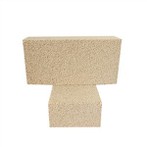
Lightweight insulation bricks and refractory bricks are commonly used refractory materials and insulation materials in kilns and various high-temperature equipment. Although they are all brick refractory materials, their performance and use are completely different. Today I will introduce the main functions of the two And difference.
The main function of lightweight thermal insulation bricks is to keep warm and reduce heat loss. Thermal insulation bricks generally do not directly touch the flame, while refractory bricks generally directly touch the flame. Refractory bricks are mainly used to withstand the burning of flames. Generally divided into two types, namely unshaped refractories and shaped refractories.
stereotyped refractory materials, generally made of refractory bricks, the shape of which has standard rules, and it can also be processed temporarily during construction and cutting as required.
The main differences between lightweight insulation bricks and refractory bricks are as follows:
1. Thermal insulation performance: The thermal conductivity of thermal insulation bricks is generally 0.2-0.4 (average temperature 350±25℃) w/mk, while the thermal conductivity of refractory bricks is above 1.0 (average temperature 350±25℃) w/mk, so It can be concluded that the thermal insulation performance of thermal insulation bricks is much better than that of refractory bricks.
2. Refractoriness: The refractoriness of insulation bricks is generally below 1400 degrees, while the refractoriness of refractory bricks is above 1400 degrees.
3. Density: Insulation bricks are generally light-weight insulation materials, with a density of 0.8-1.0g/cm3 and the density of refractory bricks is basically above 2.0g/cm3. In general, refractory bricks have high mechanical strength, long service life, good chemical stability, no chemical reaction with materials and good high temperature resistance. The maximum heat resistance temperature can reach 1900°C. It is especially suitable for high and low temperature shift furnaces, reformers, hydroconverters, desulfurization tanks and methanizers in chemical fertilizer plants, and plays the role of dispersing gas and liquid, and supporting, covering and protecting catalysts. It can also be used in hot blast stoves and heating conversion equipment in the iron and steel industry.
Refractory bricks have the advantages of high density, high strength, wear resistance, good corrosion resistance, low thermal expansion coefficient, high grinding efficiency, low noise, long service life, and non-contaminating materials. It is a high-quality grinding medium suitable for various grinding machines.
Refractory bricks are very different from lightweight insulation bricks, and their use environment, scope and function are different. Different materials will be used in different positions. When choosing materials, we must decide which refractory material is suitable for our own use according to our actual situation.