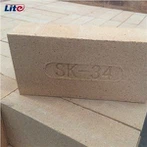
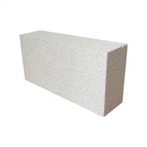
As a common type of brick, refractory brick has the characteristics of abrasion resistance and impact resistance, and it has a wide range of uses. Due to the different composition of raw materials, refractory bricks are divided into several types. Here are a few commonly used refractory bricks and their uses.
1. Ordinary clay bricks. This material belongs to weak acid refractory brick, suitable for high temperature furnace and environment in acid atmosphere. It has the characteristics of good thermal shock resistance, acid corrosion resistance and high strength. Ordinary refractory clay bricks are used for refractory masonry, lining materials, furnace walls, furnace bottoms, flues, etc. of general furnaces at temperatures below 1250°C. Its refractory temperature can reach above 1700℃, but it cannot be used as a long-term use temperature. According to different uses, it can be divided into blast furnace clay bricks, hot blast stove clay bricks, glass kiln clay bricks, and low creep clay bricks.
2.high alumina bricks. This material is a neutral refractory brick, which has strong resistance to acid and alkali chemical attack, and its resistance to acid attack increases as the aluminum content decreases. The thermal shock resistance is worse than that of refractory clay bricks. It has high fire resistance and service temperature, structural strength and wear resistance. High-alumina bricks are suitable for general furnaces and kilns with high temperature resistance and wear resistance, or large-load masonry, burner bricks and masonry with special requirements. The dome of the high temperature zone of the combustion chamber allows the use temperature of 1300~1650℃. According to the different aluminum content, it can be divided into special grade high alumina brick, first grade high alumina brick, second grade high alumina brick, and third grade high alumina brick. According to different uses, it can be divided into multiple categories such as hot blast stove high alumina bricks, blast furnace high alumina bricks, Shenggang barrel high alumina bricks, and Shenggang barrel cast high alumina bricks.
3. Lightweight clay bricks. This material is a kind of lightweight thermal insulation refractory brick with high porosity, low thermal conductivity, low volume density and low compressive strength. It is often used as an insulation material for high-temperature equipment, which can reduce the temperature around high-temperature equipment. , It is convenient for the normal operation of workers, can reduce heat loss, save energy and reduce costs. Lightweight refractory clay bricks are used as kiln linings that are not corroded by high-temperature slag and corrosive gases. Depending on the capacity, the service temperature is between 1150 and 1400°C.
4. Lightweight high alumina bricks. The material is high-alumina thermal insulation refractory bricks. Its characteristics are the same as that of light clay bricks, and the material and service temperature of light high alumina bricks are higher than that of light clay bricks. It is used for heat-resistant linings whose working temperature is lower than 1350℃, and can also be used for masonry without high-temperature melt erosion and erosion, and can be directly in contact with flames. The operating temperature is 1350-1500℃. Especially lightweight high-alumina bricks based on fused or sintered alumina, also known as lightweight corundum bricks, can be used at a temperature of 1650-1800°C. They are used as heat-resistant and heat-insulating linings for high-temperature furnaces. Lining eroded by high temperature and high pressure water vapor.
5. Lightweight mullite brick, the material is mainly based on mullite crystal phase, light high alumina bauxite clinker or mullite clinker as the main raw material, and it is also a kind of heat insulation refractory brick . It has the characteristics of high structural strength at high temperature, low creep rate at high temperature, low thermal expansion coefficient, strong chemical resistance, and strong thermal shock resistance. It is suitable for industrial kiln insulation materials with frequent temperature changes or intermittent operation. It is used as the lining of the working face directly in contact with the flame, which significantly improves the energy-saving effect of the high-temperature furnace.